As leadership changes with Center for Black Literature, its goals steadfastly remain the same

By David Gil de Rubio | dgilderubio@mec.cuny.edu
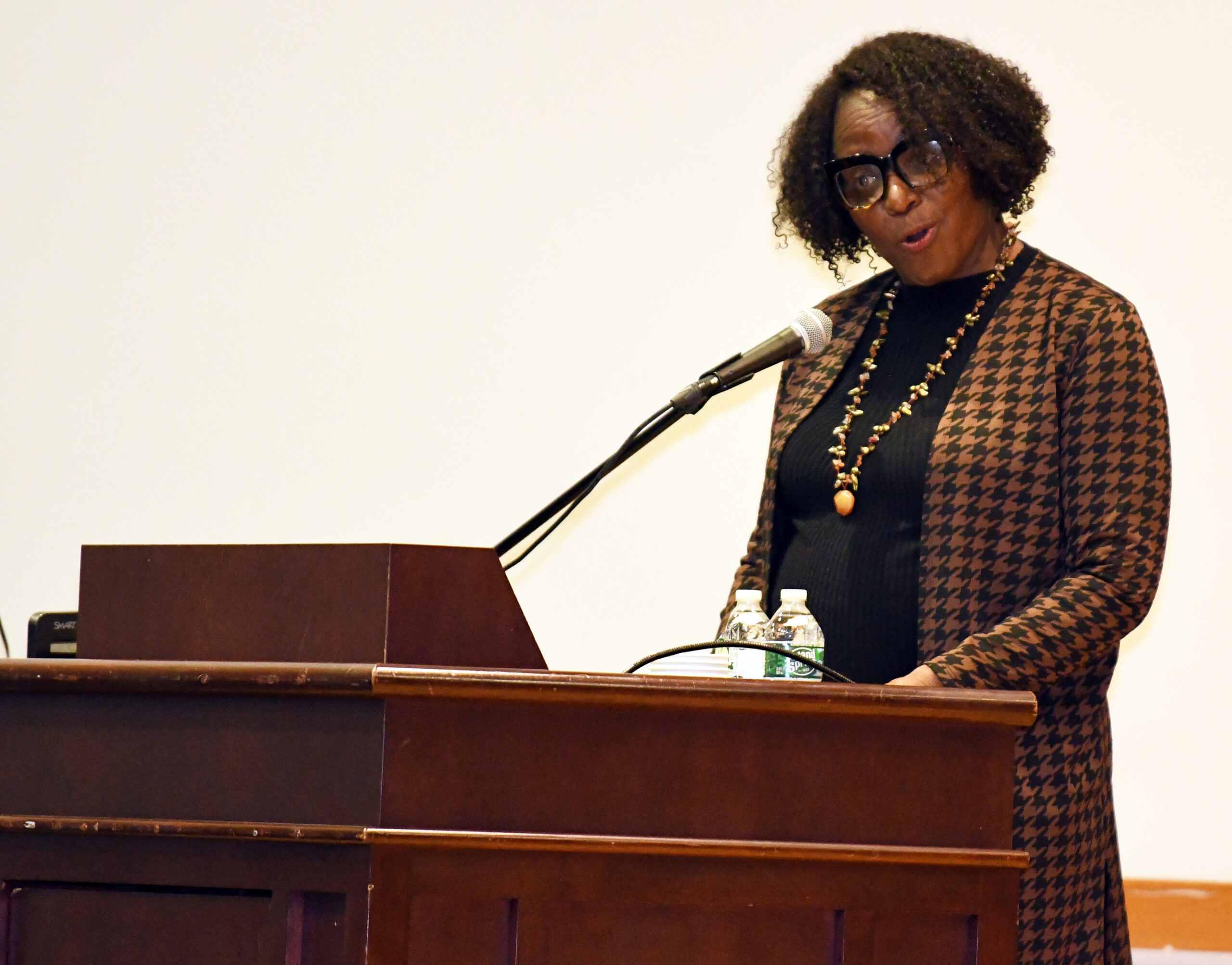
When Professor Donna Hill was named executive director of the Center for Black Literature (CBL), she succeeded Dr. Brenda Greene. It was also the latest chapter in Hill’s long relationship with the CBL and Greene.
For the Medgar Evers College Assistant English Professor, this connection with the CBL founder dates back to the early 1990s when both authors were crossing paths in and around the Central Brooklyn community.
“Two things always come to mind when I think back to when I first met [Dr. Greene],” Hill said. “Nkiru Books, where I used to visit the owners. And then her and her son took it over, so they know me from there. Her son and my son both went to the same elementary school, so we would see each other again where we would go to different events. I knew her then. At that point, I was doing writing workshops for the Center, so that was sort of my connection to it from back then, because I had started being published back then and started doing these events.”
As someone who has more than 100 titles published and counting, Hill’s bona fides are solid and go beyond her being an assistant professor of professional writing that started as an adjunct at Medgar Evers College in 2013.
The Brooklyn native has won numerous accolades including the Zora Neale Hurston Award for Literature.
Not surprisingly, it’s no surprise that Hill would be a natural fit to succeed Greene, especially given how Hill feels about the CBL.
“It’s important for us to be able to hold on to the treasure trove of literary giants that the center has hosted and been connected with over the past 20 years. What we do is essentially hold and maintain the history of Black literature,” said Hill.
“Our mission initially was to make sure that these are the things that we do and we want to make people aware that now, even more than ever, it is our responsibility to maintain the history of what it is that we do and all of the writers that we touch and will continue to touch because of all that is happening around us.”
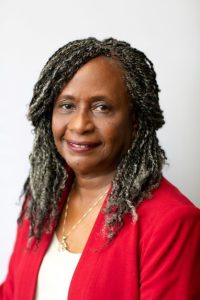
Established in 2002, the CBL has been front and center in its mission to expand and enrich public knowledge and appreciation of Black literature. It’s a role that Greene, who was Chair of the Medgar Evers College Department of Literature, Languages and Philosophy at the time, took very seriously and continued building on up until she decided to pass the baton to Hill in January 2025.
Just last year, Greene succeeded in getting the CBL’s archives digitized in the shape of “The History and Legacy of the Center for Black Literature: An Online Exhibition.” It was one of the last major projects Greene worked on and felt was a long time coming.
“[The CBL is] affecting youth, affecting elders and looking at trends and the intersections of art, literature and music,” Greene explained. “We are recognizing that you cannot look at literature from one perspective. We are showcasing emerging, as well as emerging writers and artists. We’re celebrating Black culture in all its forms.”
Hill’s ascension to the CBL executive director position started with conversations she had with Greene last year. Before that, Hill stepped into the role of the center’s literary director in 2023, so she had some familiarity with how the organization operated.
It also helped that she had already been working alongside Amber Magruder (Director of Operations and Literary Programs), Charlotte Hunter (Director, Development and External Relations/Chief of Staff) and Lea Byrd (Executive Assistant).
There still proved to be a huge learning curve given the cutbacks the CBL had to navigate in 2025.
“The most difficult part for me in this role is the financial aspect of it all,” Hill said. “The stickiest part has been the responsibility now of maintaining the finances of this organization. But I have two really competent people in that area that are still sort of holding my hand and guiding me. I make more of the decisions once they present the information, but they really handle the nuts and bolts of moving things around and all of that.”
Hill added, “I came in with high hopes thinking this was all going to be great and then boom, we get hit with our funding from the National Endowment for the Arts getting cancelled. It’s a month into the job. And it’s like ‘Oh my goodness, what are we going to do?’ That was sort of our first crisis. We had to figure out how we operate without this block of funds. What else can we do? Do we streamline things? Do we cut things out? Do we move things around? That’s kind of what we’ve been doing.”
Part of navigating the economics of running the CBL has been centered on outreach to subscribers and board members. In the meantime, Hill is laser-focused on carrying on the legacy of the CBL.
“Our mission is to ensure the legacy of Black literature across the diaspora to enhance and encourage reading, writing and support of Black and writers of color’s work — new writers, seasoned writers, artists, poets — so now, in the times that we’re in, what we do is even more important,” she said.
The work of the CBL continues with the most recent event being the annual Wild Seed Retreat for Writers of Color which took place at SUNY Polytechnic Institute in Utica, NY from Sunday, July 20 to Saturday, July 26. This tuition-based, weeklong writing retreat offers writers of color a unique opportunity to deepen their craft, build community, and receive personalized mentorship from acclaimed literary voices.

Next up for the CBL is the “Black Women in Publishing” virtual event that will be taking place on Thursdays in August that Hill put together.
“It’s a four-week series where we’ll have four Black women editors, vice presidents of publishing, that will be talking for an hour, from 3 to 4 p.m. about their journey, what publishing is looking for these days and how to break in,” she explained. “It’ll be live, so there will be a Q&A.”
Participants will be Abby West from Amistad Books on August 7, Marva Allen from Wordee Publishing on August 14, Glenda Howard from Harlequin on August 21 and Monique Patterson from St. Martins/Tor on August 28.
The other upcoming event finds the CBL participating in September’s Brooklyn Book Festival. September 17, the CBL will be hosting their own Bookend event that is part of the Brooklyn Book Festival’s 20th anniversary celebration. CBL’s event is a virtual event with a three-author panel addressing the theme “We Refuse To Be Silent: Black Women the and Their Sons.” The CBL will also have a table on Festival Day, September 21.
As for the future, Hill and her team are working on pulling together the next National Black Writers Conference, which is held every March. In the meantime, Hill is looking to cast a wider net to raise the profile of the CBL.
“I would really like to get us to a position where we are not only recognized in the Tri-State area for example, but looking at how we can take what we do internationally,” she said. “It’s an idea that I’ve been talking to a colleague about along with looking at how we can partner with the Caribbean Heritage Center at Medgar Evers College. It’s a way to take what Dr. Greene has built over the past 20 years and take that to the next level.”
Hill paused before adding, “What does that look like? It looks like taking us beyond our doorway and stepping outside to something else. That’s kind of what I’m thinking — a broader and bigger [vision]. How can we engage on a different level — on an international level? Because it’s there and probably able to pull in different kinds of dollars because of that.”